
A simple way for tax and accounting firm owners to check if they have enough capacity for tax season, and what to do before January if they don't.

Most firm owners find out they're short on capacity in February, when their Saturdays stop being theirs.
By then it's too late to fix. You can't hire, train and hand off work in the middle of busy season, so most owners absorb the gap themselves with nights, weekends and a pile of extensions.
The short answer: compare the hours your returns will need with the hours your team has after admin and interruptions. If the work needs more than about 80% of those hours, your firm doesn't have enough capacity for tax season. Tax season capacity planning takes about an hour, and October through December is the time to do it.
How do I calculate my firm's tax season capacity?
You need two numbers.
1. Hours needed. Multiply the returns you expect by the average hours each one takes from start to finish. Include prep, review, document chasing and client questions, not only the time in the software.
2. Hours available. Multiply the people doing the work by their weekly hours and the weeks in your season. Then take out about 30% for meetings, interruptions, email and admin, because that time never goes to returns.
Here's an example with round numbers:
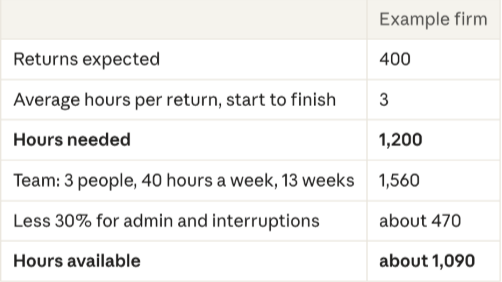
This firm is short about 110 hours before a single new client signs, a team member gets sick or an extension wave hits. On paper the team looked fine. In practice, the owner is the one who covers those 110 hours.
What are the signs my firm is over capacity?
If any of these happened last season, your accounting firm capacity was stretched:
You worked most weekends from February through April
Extensions went out because the work wasn't done, not because documents were missing
Client response times slipped past a day or two
Your preparers spent hours on scheduling, reminders and status updates
You turned away good clients, or took them and regretted it
What if my firm doesn't have enough capacity?
You have more options than you think. Start with the ones that free up the most hours.
Move admin off your preparers. Document collection, reminders, scheduling and status updates often eat a third of a preparer's week. Our virtual assistant services for tax and accounting firms are built for this work.
Fix how documents come in. A client portal with automatic reminders saves hours of chasing. We handle TaxDome setup and Canopy setup for firms that want it running before January.
Set client deadlines now. Tell clients the date documents are due to be done by April 15. Late documents mean an extension, decided in advance.
Be choosy about new clients. Raise prices or close intake for the season once you're near your limit.
Add support by mid-December. New help needs a few weeks to learn your firm and your software before the volume hits.
If you'd like a partner to look at the whole picture, our operations support for accounting firms covers the systems, the people and the workflow together. You can read what firm owners say on our Client Love page.
When should I plan for tax season capacity?
October through December, during pre-busy season. That's when you still have time to hire, set up systems and train support. For more on protecting your time once the season starts, read How Do I Keep Tax Season From Taking Over My Whole Life?
Frequently Asked Questions
How many tax returns can one preparer handle in a season? It depends on the mix of returns. A useful check is to divide that preparer's available hours, after admin, by your average hours per return. Most firms overestimate this number because they forget the admin time.
What percentage of capacity should my firm plan for? Plan to use about 80% of your available hours. The other 20% covers sick days, complex returns and late documents.
Should I hire or outsource for tax season? If the gap is mostly admin and only lasts January to April, outsourcing to a team that knows tax firms is usually faster to set up and easier to scale down than a new full-time hire.
Does this work for fractional CFOs? Yes. Use client engagements and monthly hours instead of returns, and plan around your clients' busiest reporting periods.
Find out where your capacity stands before January
At Guy & Associates, we're the operations and marketing partner for tax firms, accounting firms and fractional CFOs. We help you find the hours you're losing and build the support to get them back.
To be fully onboarded before tax season, we need to start by December 12. Book a Stop Being the Bottleneck Strategy Call, and we'll run your capacity numbers together. You can also meet our team or see all of our services.
Want more like this? Join the newsletter or browse more posts on the G&A blog.